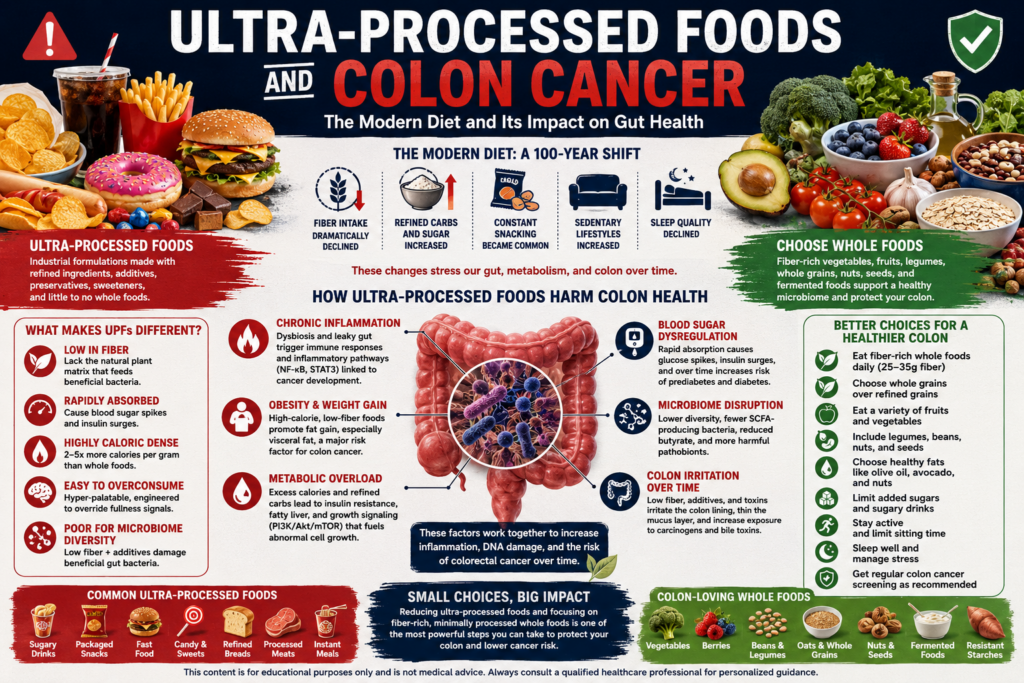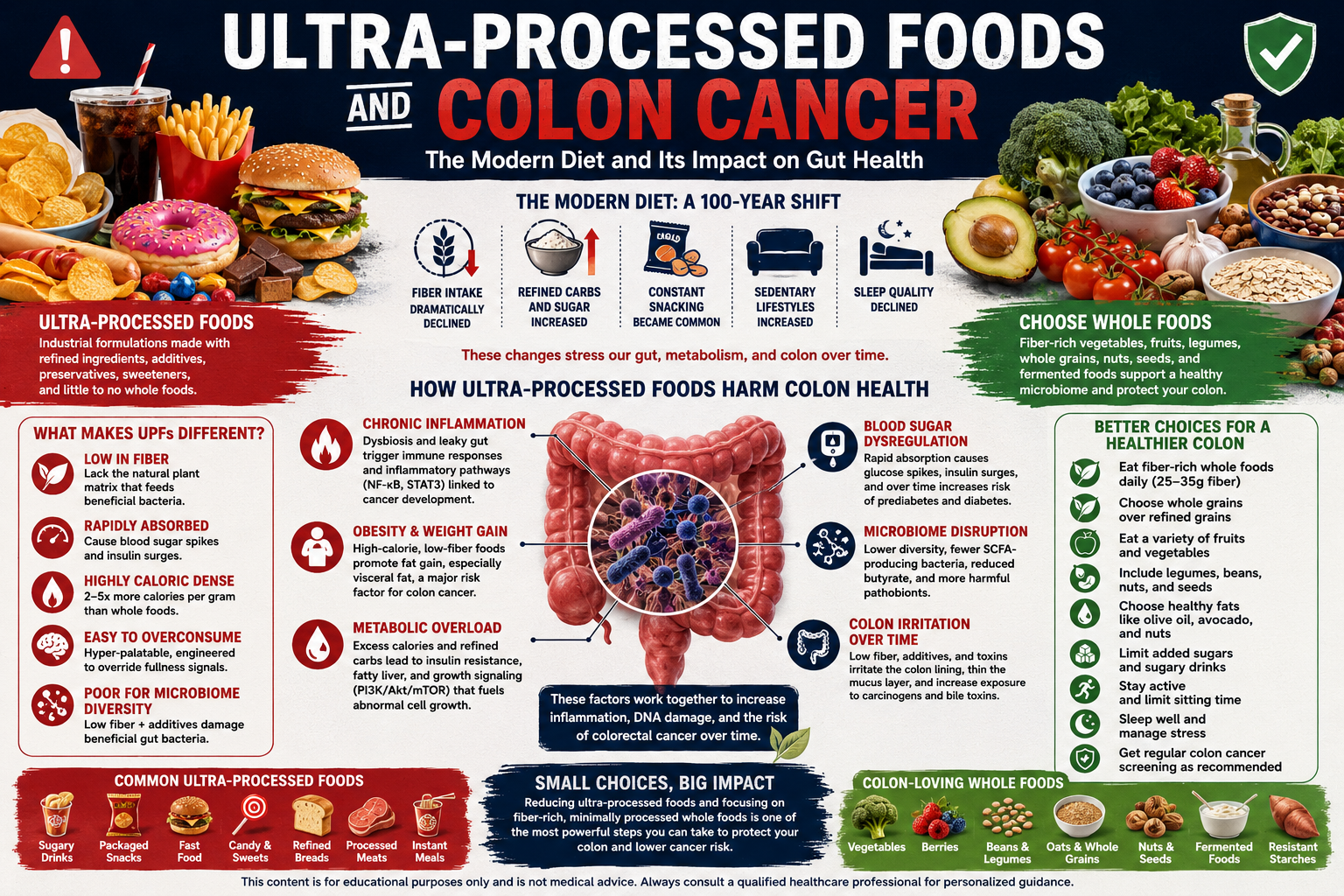
One of the biggest modern concerns in colon health is the explosion of ultra-processed foods.
Ultra-processed foods are not just “junk food.” They are industrial food products designed to be cheap, convenient, shelf-stable, flavorful, and easy to overeat.
Many are made from refined starches, added sugars, seed oils, flavorings, emulsifiers, preservatives, artificial sweeteners, colorings, and isolated food ingredients.
They often look like food, taste like food, and fill the stomach like food — but they do not behave inside the body like whole foods.
That difference matters.
Researchers are increasingly studying how ultra-processed foods may affect the gut microbiome, inflammation, insulin resistance, obesity, blood sugar regulation, and long-term colorectal cancer risk.
This does not mean one packaged snack causes colon cancer.
The concern is the long-term pattern.
When ultra-processed foods replace fiber-rich whole foods for years or decades, the digestive system, microbiome, metabolism, and colon lining may all be affected.
People Also Ask About Ultra-Processed Foods and Colon Cancer
As colon cancer rates rise, especially in younger adults, many people are asking:
- What are ultra-processed foods?
- Do ultra-processed foods increase colon cancer risk?
- How do processed foods affect the gut microbiome?
- Can refined carbohydrates damage gut health?
- Does sugar increase colon cancer risk?
- Why is low fiber bad for the colon?
- How do ultra-processed foods cause inflammation?
- Can food additives affect the gut barrier?
- What is metabolic overload?
- How does constant snacking affect insulin?
- Can poor sleep and sedentary lifestyle affect colon cancer risk?
- What foods damage the gut microbiome?
- What foods should be reduced for colon health?
- Are all processed foods bad?
- How can I replace ultra-processed foods with healthier options?
This article focuses on how ultra-processed foods and the modern diet may influence long-term colon health.
What Are Ultra-Processed Foods?
Ultra-processed foods are industrially formulated products made mostly from refined ingredients and additives.
They are usually very different from whole foods.
Common examples include:
- Sugary drinks
- Packaged snack cakes
- Candy
- Fast food
- Frozen pizzas
- Instant noodles
- Many breakfast cereals
- Processed meat products
- Chips and packaged snacks
- Sweetened coffee drinks
- Many ready-to-eat meals
- Reconstituted meat products
- Highly sweetened yogurts or desserts
Not every packaged food is equally harmful.
For example, frozen vegetables, plain Greek yogurt, canned beans, or plain oats may be processed but are not the same as ultra-processed snack foods.
The main concern is foods that are heavily engineered, low in fiber, rapidly absorbed, highly calorically dense, and easy to overconsume.
What Changed in the Modern Diet?
Over the past 100 years, the human diet changed dramatically.
Many people now eat more:
- Refined flour
- Added sugar
- Sweet drinks
- Packaged snacks
- Fast food
- Processed meats
- Ready-to-eat meals
- Industrial oils
- Artificial flavors and additives
At the same time, many people eat less:
- Fiber
- Beans
- Lentils
- Vegetables
- Whole fruit
- Whole grains
- Resistant starch
- Fermented foods
- Naturally structured whole foods
Lifestyle changed too.
Many people now experience:
- More constant snacking
- Less fasting time between meals
- More sedentary time
- Less physical activity
- Worse sleep quality
- More circadian rhythm disruption
- Higher stress
This combination creates what many researchers now describe as a modern metabolic and inflammatory environment.
The colon is not separate from that environment.
It is directly exposed to it every day.
Why Ultra-Processed Foods Are Different From Whole Foods
Whole foods usually contain structure.
That structure includes:
- Fiber
- Water
- Minerals
- Polyphenols
- Natural fats
- Protein structure
- Plant cell walls
- Slowly digested carbohydrates
Ultra-processed foods often remove or destroy much of that structure.
That makes them easier to chew, easier to digest, faster to absorb, and easier to overeat.
This is one reason drinking fruit juice is not the same as eating whole fruit.
Whole fruit contains fiber, water, plant compounds, and structure that slow absorption.
Fruit juice removes much of that structure and allows sugar to hit the body faster.
The same idea applies to many modern refined foods.
The food is not only different because of calories.
It is different because of how fast the body absorbs it and how little support it gives the gut microbiome.
Many Ultra-Processed Foods Are Low in Fiber
Fiber is one of the most important nutrients for colon health.
Fiber helps:
- Feed beneficial gut bacteria
- Support bowel regularity
- Increase stool bulk
- Slow glucose absorption
- Support short-chain fatty acid production
- Help maintain the gut mucus layer
- Support gut barrier integrity
Many ultra-processed foods are low in fiber.
When low-fiber foods replace beans, vegetables, whole fruit, lentils, oats, nuts, seeds, and resistant starch, beneficial gut bacteria may lose their main fuel source.
This matters because gut bacteria ferment fiber into short-chain fatty acids such as butyrate.
Butyrate helps support colon cells, gut barrier integrity, and inflammation control.
Low fiber may mean lower butyrate production.
Lower butyrate may mean a less protective colon environment.
Rapid Absorption and Blood Sugar Spikes
Many ultra-processed foods are made from refined carbohydrates and added sugars.
These foods can digest quickly and enter the bloodstream rapidly.
This may cause repeated spikes in:
- Blood glucose
- Insulin
- Triglycerides
- Hunger signals
- Energy crashes
Occasional spikes are normal.
The concern is repeated spikes throughout the day for years.
Frequent glucose and insulin spikes may contribute to insulin resistance.
Insulin resistance is when the body needs more insulin to handle the same amount of glucose.
This matters for colon health because insulin resistance, obesity, type 2 diabetes, and chronic inflammation are linked with higher colorectal cancer risk.
Metabolic Overload
Metabolic overload happens when the body is constantly forced to process more energy than it can efficiently use or store.
Ultra-processed foods can contribute to metabolic overload because they are often:
- Calorie dense
- Quickly absorbed
- Low in fiber
- Easy to overeat
- Designed for repeated snacking
- High in sugar, refined starch, fat, and salt combinations
Over time, metabolic overload may contribute to:
- Weight gain
- Visceral fat
- Fatty liver
- Insulin resistance
- Higher inflammation
- Blood sugar dysregulation
- Hormonal disruption
This creates a body-wide environment that may be less protective against cancer development.
The colon is affected by this because colon cells respond to insulin, inflammation, immune signaling, bile acids, and metabolic stress.
Easy to Overconsume
Ultra-processed foods are often designed to be hyper-palatable.
That means they are made to taste extremely rewarding.
They often combine:
- Sugar
- Refined starch
- Salt
- Fat
- Flavor enhancers
- Soft texture
- Low chewing effort
- High calorie density
This can make it easy to eat more calories before the body has time to feel full.
A randomized feeding study found that people ate more calories on an ultra-processed diet compared with an unprocessed diet, even when the meals were matched for calories, sugar, fat, fiber, and macronutrients offered.
This suggests food processing itself may affect how much people naturally eat.
Over time, this can promote weight gain and metabolic dysfunction.
Poor for Microbiome Diversity
The gut microbiome depends heavily on what reaches the colon.
Fiber-rich whole foods feed one type of microbiome.
Ultra-processed, low-fiber foods may feed a very different environment.
A low-fiber, high-UPF diet may contribute to:
- Lower microbial diversity
- Fewer butyrate-producing bacteria
- Reduced short-chain fatty acids
- More inflammatory bacteria
- Weaker gut barrier function
- More gut irritation
This is one reason ultra-processed foods are being studied in colorectal cancer research.
They may change not only body weight and blood sugar, but also the microbial environment inside the colon.
Food Additives, Emulsifiers, and the Gut Barrier
Some ultra-processed foods contain additives such as emulsifiers, thickeners, artificial sweeteners, preservatives, flavor enhancers, and colorings.
Not every additive is proven harmful in humans.
But researchers are studying whether certain additives may affect the gut microbiome and gut barrier.
Some animal studies suggest certain emulsifiers may:
- Change gut bacteria
- Thin the mucus layer
- Increase bacterial contact with the intestinal wall
- Promote low-grade inflammation
- Increase intestinal permeability
- Worsen colon tumor development in susceptible models
This does not mean every emulsifier causes cancer in humans.
But it does suggest the modern food-additive environment may matter, especially when combined with low fiber, obesity, insulin resistance, and microbiome disruption.
Chronic Inflammation
Chronic inflammation is one of the biggest concerns in colon cancer research.
Ultra-processed foods may contribute to inflammation through several pathways:
- Gut microbiome disruption
- Lower short-chain fatty acid production
- Weaker gut barrier integrity
- Blood sugar spikes
- Insulin resistance
- Weight gain
- Visceral fat
- Additive-related gut irritation
- Low intake of protective plant compounds
Inflammation can damage tissue over time.
Long-term inflammation may contribute to DNA damage, oxidative stress, abnormal cell signaling, and a less protective immune environment.
This is why the modern diet is not only a weight problem.
It may also be an inflammation problem.
Obesity and Colon Cancer Risk
Ultra-processed food intake is strongly connected to overeating and weight gain in many people.
Obesity is a well-established risk factor for colorectal cancer.
Obesity may increase colon cancer risk through:
- Insulin resistance
- Higher insulin and IGF-1 signaling
- Chronic inflammation
- Visceral fat inflammation
- Altered bile acids
- Hormonal changes
- Lower physical activity
This is important because many people only think about colon cancer as a digestive problem.
But colon cancer risk is also connected to the whole metabolic state of the body.
Blood Sugar Dysregulation
Blood sugar dysregulation means the body has trouble maintaining stable glucose levels.
This may include:
- Frequent glucose spikes
- Insulin resistance
- High fasting insulin
- Prediabetes
- Type 2 diabetes
- Fatty liver
Ultra-processed foods may contribute to blood sugar dysregulation because many are high in refined carbohydrates and added sugars while being low in fiber.
Fiber slows absorption.
Protein, healthy fats, and intact food structure also slow absorption.
Ultra-processed foods often remove that slowing effect.
This may make the body work harder to control blood sugar.
Over time, that may contribute to metabolic stress and inflammation.
Colon Irritation Over Time
Colon irritation does not always mean immediate pain.
It can mean a long-term environment of:
- Low fiber
- Poor stool bulk
- Slower transit time
- Less butyrate
- More inflammatory bacteria
- More bile acid irritation
- More gut barrier stress
- More exposure to harmful metabolites
When stool moves slowly and fiber is low, the colon lining may have longer contact with irritating substances.
Fiber helps move waste through the colon and supports a healthier stool environment.
This may be one reason higher fiber intake is associated with lower colorectal cancer risk in many studies.
Constant Snacking and the Always-Fed State
Ultra-processed foods made constant snacking easier than ever.
Many people now eat from morning until night.
This creates an almost constant fed state.
Constant eating may contribute to:
- More frequent insulin release
- Less metabolic rest
- Less time in fat-burning mode
- More digestive workload
- More calorie intake
- More blood sugar swings
This does not mean everyone must fast aggressively.
But the modern pattern of eating refined, low-fiber foods all day may contribute to metabolic overload.
Time-restricted eating and longer breaks between meals are being studied because they may improve insulin sensitivity and metabolic flexibility in some people.
Sedentary Lifestyle
Modern food changed, but modern movement changed too.
Many people now sit for long periods due to work, transportation, screens, and modern entertainment.
Sedentary behavior may increase colon cancer risk by contributing to:
- Slower gut motility
- Weight gain
- Insulin resistance
- Chronic inflammation
- Poor metabolic flexibility
- Lower muscle glucose uptake
Exercise helps improve insulin sensitivity and may support healthier bowel movement, immune function, and inflammation control.
The issue is not only what people eat.
It is also how little many people move.
Sleep Quality and Circadian Disruption
Sleep also matters for metabolism and gut health.
Poor sleep may contribute to:
- Higher hunger hormones
- Lower insulin sensitivity
- Weight gain
- More cravings
- Higher inflammation
- Gut microbiome changes
- Circadian rhythm disruption
The gut microbiome follows daily rhythms.
Eating late at night, poor sleep, shift work, and irregular schedules may disrupt normal metabolic timing.
This can add another layer to the modern colon health problem.
Ultra-processed foods, late-night eating, poor sleep, and low activity often travel together.
Are All Processed Foods Bad?
No.
This is important.
Not all processed foods are the same.
Helpful or reasonable processed foods may include:
- Frozen vegetables
- Plain Greek yogurt
- Kefir
- Canned beans
- Plain oats
- Olive oil
- Nut butters without added sugar
- Canned fish
- Pre-cut vegetables
- Plain frozen fruit
The concern is not basic food preparation.
The concern is ultra-processing.
Ultra-processed foods are usually engineered products that are low in fiber, rapidly absorbed, calorie dense, highly rewarding, and poor at supporting the microbiome.
Practical Swaps for Colon Health
Instead of sugary cereal:
Try steel-cut oats, chia seeds, berries, or plain Greek yogurt.
Instead of chips:
Try nuts, roasted chickpeas, vegetables with hummus, or olives.
Instead of soda:
Try sparkling water, unsweetened tea, or water with lemon.
Instead of fast food burgers and fries:
Try a home meal with protein, vegetables, beans, salad, or cooked-and-cooled starch if tolerated.
Instead of sweet snack bars:
Try berries, nuts, boiled eggs, plain yogurt, or whole fruit.
Instead of white bread and pastries:
Try higher-fiber options such as oats, beans, lentils, vegetables, or whole-food carbohydrate sources if tolerated.
The goal is not perfection.
The goal is replacing the foods that damage the gut environment most often.
The Big Picture
Ultra-processed foods may increase colon cancer risk through multiple overlapping pathways.
They may:
- Reduce fiber intake
- Reduce short-chain fatty acid production
- Disrupt the microbiome
- Increase blood sugar spikes
- Increase insulin resistance
- Promote weight gain
- Increase inflammation
- Weaken gut barrier integrity
- Irritate the colon lining over time
- Encourage constant snacking
- Replace protective whole foods
This is why ultra-processed foods are such a major modern concern.
They do not act through only one pathway.
They change the whole food environment.
Final Thoughts
The rise of ultra-processed foods may be one of the most important dietary changes of the modern era.
Over the past century, fiber intake declined, refined carbohydrates increased, added sugar consumption increased, constant snacking became normal, sedentary living increased, and sleep quality declined.
Together, these changes may contribute to chronic inflammation, obesity, metabolic overload, blood sugar dysregulation, gut microbiome disruption, and colon irritation over time.
Reducing ultra-processed foods and replacing them with fiber-rich, minimally processed whole foods may be one of the most practical strategies for supporting long-term colon health.
This does not mean diet can guarantee prevention.
It does mean the daily food environment matters.
Colon cancer risk is shaped over years and decades, and the modern diet may be one major piece of that story.
Internal Links
- Colon Cancer Reduction: Metabolic Health, Gut Health, and Lifestyle Factors
- The Gut Microbiome and Colon Health
- Akkermansia muciniphila and Colon Cancer
- Fiber and Colon Cancer Prevention
- Resistant Starch and Gut Health
- Insulin Resistance and Colon Cancer
- Inflammation and Colon Cancer
- Obesity and Colon Cancer
- Fasting and Colon Cancer Research
- Hypoxia and HIF-1α in Cancer
External Authority Sources
- BMJ: Ultra-Processed Food Consumption and Colorectal Cancer Risk — Large cohort study examining the relationship between ultra-processed food intake and colorectal cancer risk.
- NIH / PubMed Central: Ultra-Processed Foods and Colorectal Cancer Meta-Analysis — Systematic review and meta-analysis discussing ultra-processed foods, inflammation, obesity, microbiome disruption, and colorectal cancer risk.
- NIH / PubMed Central: Ultra-Processed Foods and Colorectal Neoplasia — Review covering ultra-processed foods, colorectal adenomas, gut microbiota disruption, inflammation, and tumor development.
- NIH / PubMed Central: Dietary Emulsifiers, Microbiota, Inflammation, and Colon Cancer Models — Research discussing how dietary emulsifiers may alter the microbiome, weaken the mucus layer, increase inflammation, and promote colon tumor formation in animal models.
- American Cancer Society: Colorectal Cancer Prevention — Evidence-based guidance on reducing colorectal cancer risk through body weight, diet, physical activity, alcohol reduction, smoking cessation, and screening.
- National Cancer Institute: Colorectal Cancer Risk Factors and Prevention — National Cancer Institute overview of colorectal cancer prevention, risk factors, obesity, diet, inflammation, and screening.
Medical Disclaimer
This article is for educational and informational purposes only and is not medical advice. It does not diagnose, treat, cure, or prevent any disease. Always speak with a qualified healthcare professional about colon cancer risk, digestive symptoms, screening, diet changes, fasting, supplements, or medical treatment decisions.