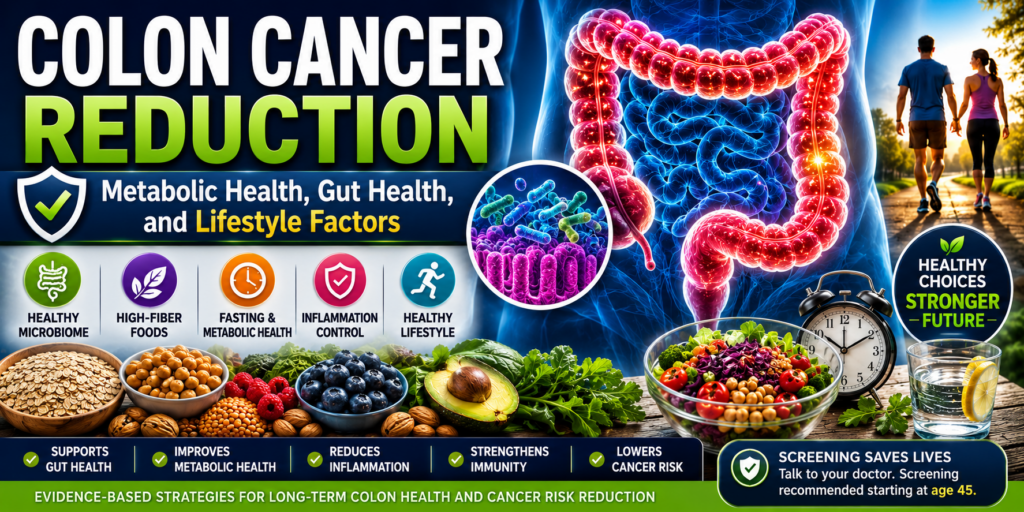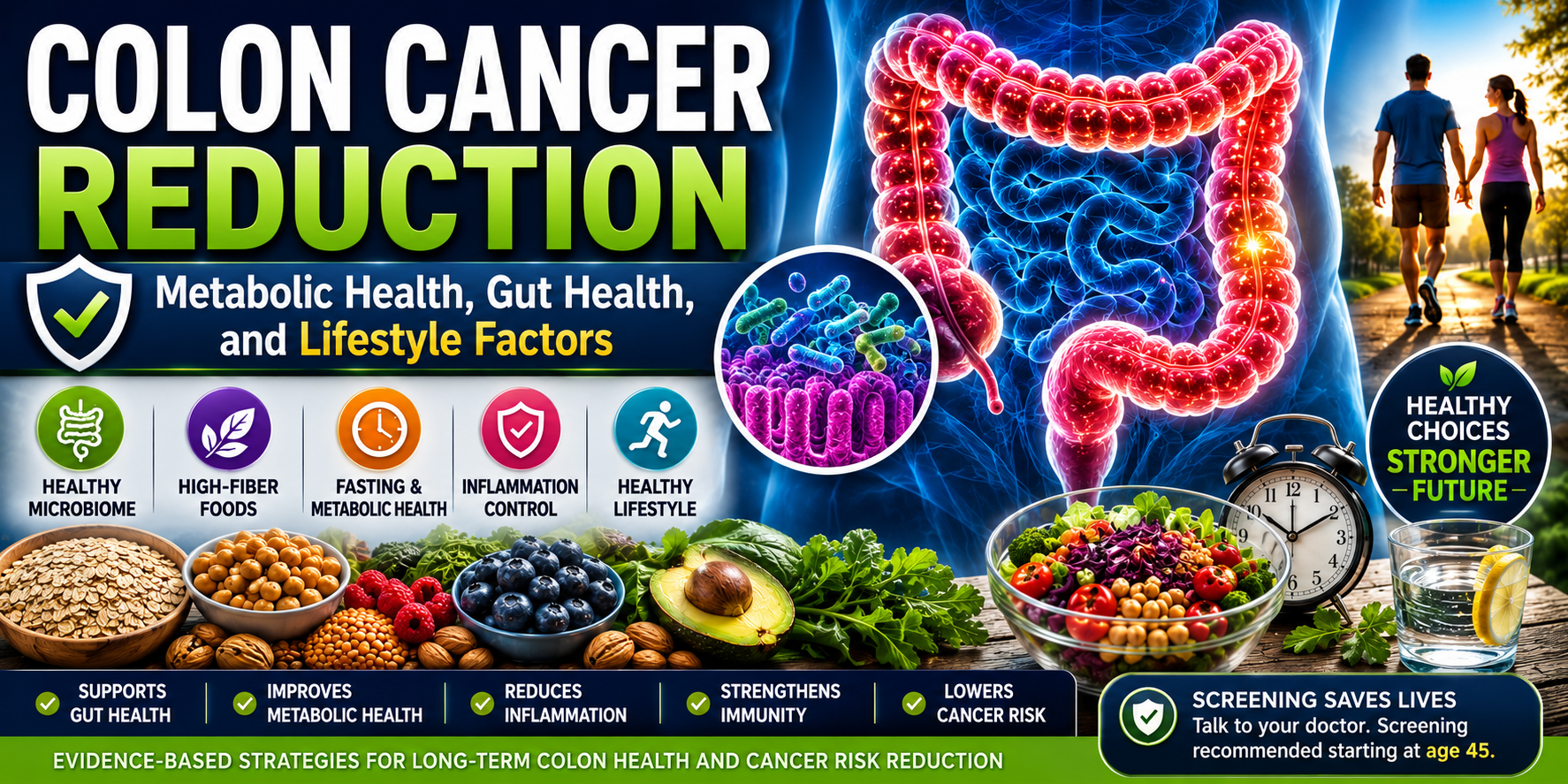
Colon Cancer Is Rising
Colon cancer rates are increasing, especially in younger adults, and many people are now asking deeper questions about what may be contributing to this trend.
Common questions people are now researching include:
- What causes colon cancer?
- Does gut health affect colon cancer?
- Can fasting help colon cancer prevention?
- Does fiber reduce colon cancer risk?
- What foods damage the gut microbiome?
- How do ultra-processed foods affect colon health?
- What is Akkermansia muciniphila?
- Is OMAD healthy for colon health?
- How does insulin resistance affect colon cancer?
- What lifestyle changes reduce colon cancer risk?
Researchers are increasingly investigating how metabolism, inflammation, microbiome disruption, insulin resistance, obesity, diet, and modern lifestyle factors may all contribute to long-term colon health.
What Is Colon Cancer?
Colon cancer develops when cells inside the colon begin growing abnormally over long periods of time. In many cases, this process can begin years or even decades before a tumor is detected.
Researchers now believe colon cancer is influenced by many overlapping factors including:
- Diet
- Obesity
- Chronic inflammation
- Insulin resistance
- Gut microbiome disruption
- Physical inactivity
- Sleep disruption
- Ultra-processed foods
- Smoking and alcohol
- Genetics and family history
Genetics can play a major role in some individuals. Certain inherited syndromes significantly increase colon cancer risk, including:
- Lynch syndrome
- Familial adenomatous polyposis (FAP)
People with strong family histories of colon cancer or inherited cancer syndromes may require earlier and more frequent screening.
There is likely no single cause of colon cancer. Instead, it appears to be the result of multiple metabolic, inflammatory, immune, and environmental stressors stacking together over time.
The Gut Microbiome and Colon Health
The gut microbiome is the massive ecosystem of bacteria, fungi, and microorganisms living inside the digestive tract.
Researchers now believe the microbiome may play a major role in:
- Colon lining protection
- Immune regulation
- Inflammation control
- Nutrient metabolism
- Blood sugar regulation
- Short-chain fatty acid production
- Gut barrier integrity
A healthy microbiome may help create a more protective colon environment.
Akkermansia muciniphila
One beneficial bacteria receiving major attention in research is Akkermansia muciniphila.
This bacteria appears to help:
- Support the gut mucus lining
- Improve metabolic health
- Reduce inflammation
- Support gut barrier integrity
- Improve insulin sensitivity
Researchers are increasingly studying whether healthier gut bacteria populations may help reduce colon inflammation and improve long-term digestive health.
Ultra-Processed Foods and the Modern Diet
One of the biggest modern concerns is the explosion of ultra-processed foods.
Over the past 100 years:
- Fiber intake dramatically declined
- Refined carbohydrates increased
- Sugar consumption increased
- Constant snacking became common
- Sedentary lifestyles increased
- Sleep quality declined
Many ultra-processed foods are:
- Low in fiber
- Rapidly absorbed
- Highly calorically dense
- Easy to overconsume
- Poor for microbiome diversity
Researchers believe these changes may contribute to:
- Chronic inflammation
- Obesity
- Metabolic overload
- Blood sugar dysregulation
- Gut microbiome disruption
- Colon irritation over time
Why Fiber May Matter
Fiber is not simply “filler.”
Fiber helps:
- Slow digestion
- Reduce rapid glucose spikes
- Feed beneficial gut bacteria
- Produce short-chain fatty acids like butyrate
- Improve stool bulk and movement
- Support the mucus lining of the colon
One reason whole fruit behaves differently than fruit juice is because fiber changes how quickly sugars are absorbed.
Fiber may help create a slower, more stable metabolic environment.
Resistant Starch and Colon Health
Resistant starches are carbohydrates that resist digestion and instead feed beneficial bacteria in the colon.
Examples include:
- Cooked and cooled potatoes
- Cooked and cooled rice
- Steel-cut oats
- Green bananas
- Legumes
These resistant starches may help increase beneficial short-chain fatty acids that support colon health.
Constant Eating and Metabolic Overload
Modern humans often spend most of the day in a fed state.
Frequent meals, snacks, sugar intake, processed foods, and sweet drinks may keep:
- Insulin elevated
- Blood sugar fluctuating
- Digestion constantly active
- Growth signals elevated
Researchers are now heavily studying whether constant eating contributes to:
- Insulin resistance
- Chronic inflammation
- Obesity
- Fatty liver disease
- Metabolic dysfunction
Time-Restricted Eating, Fasting, and OMAD
Fasting and time-restricted eating are becoming major research areas.
Potential benefits being studied include:
- Improved insulin sensitivity
- Lower inflammation markers
- Better blood sugar control
- Improved metabolic flexibility
- Support of autophagy
- Reduced caloric overload
Some people prefer OMAD (One Meal A Day) because it provides long periods of digestive rest.
However, fasting is not automatically harmless.
Aggressive or prolonged fasting may contribute to:
- Fatigue
- Electrolyte imbalances
- Muscle loss
- Gallstone risk
- Cortisol elevation
- Sleep disruption
- Blood pressure swings
- Digestive stress
The goal should not be starvation.
The bigger idea may be reducing constant metabolic overload while still maintaining proper nutrition.
Keto, Weight Loss, and Gut Health
Low-carbohydrate diets can help many people lose weight and improve blood sugar control.
Reducing:
- Sugar
- Refined carbohydrates
- Ultra-processed foods
- Excessive snacking
may improve metabolic health in many individuals.
Lower glucose environments may also be beneficial while actively battling cancer because many tumors heavily depend on glucose and insulin signaling for rapid growth. However, this article is focused more on long-term colon cancer prevention and possible root causes rather than active cancer treatment strategies.
For prevention, the bigger picture appears to involve overall metabolic health, microbiome health, inflammation control, body weight, and reducing chronic metabolic overload over many years.
However, some researchers also question whether extremely low-fiber diets over long periods may negatively affect microbiome diversity in certain people.
This is why many experts now focus on:
- Metabolic flexibility
- Gut health
- Insulin control
- Fiber quality
- Whole foods
- Reduced ultra-processed foods
instead of simply labeling all carbohydrates as universally harmful.
Cancer Is More Complicated Than Glucose Alone
While many cancer cells heavily use glucose, cancer biology is far more complicated than simply “sugar feeds cancer.”
Cancer cells can adapt using multiple survival pathways.
Major pathways being studied include:
- PI3K/Akt/mTOR
- AMPK
- HIF-1α
- MYC
- NF-κB
- STAT3
- MAPK/ERK
- WNT/β-catenin
- Autophagy
- VEGF and angiogenesis
This is why researchers now focus heavily on:
- Inflammation
- Hypoxia
- Immune evasion
- Metabolic adaptation
- Tumor microenvironment
- Obesity
- Insulin resistance
- Gut health
rather than glucose alone.
Lifestyle Factors That May Help Reduce Colon Cancer Risk
Research consistently supports several lifestyle factors associated with lower colon cancer risk:
1. Maintaining Healthy Body Weight
Obesity is strongly associated with higher colon cancer risk.
2. Regular Physical Activity
Exercise may help improve:
- Insulin sensitivity
- Inflammation
- Immune function
- Weight control
3. Reducing Ultra-Processed Foods
Limiting highly processed foods may help improve:
- Microbiome diversity
- Blood sugar control
- Inflammation
- Metabolic health
4. Improving Fiber Intake
Fiber may help support:
- Gut bacteria
- Colon lining integrity
- Digestion
- Stool movement
5. Better Sleep
Poor sleep is associated with:
- Insulin resistance
- Obesity
- Inflammation
- Hormonal disruption
6. Avoiding Smoking and Excess Alcohol
Both are associated with increased colorectal cancer risk.
7. Colonoscopy Screening
One of the most powerful prevention tools is screening.
Many medical organizations now recommend average-risk colon cancer screening beginning at age 45 instead of 50 due to rising colorectal cancer rates in younger adults.
People with family history, inherited syndromes, digestive disorders, or higher risk factors may need screening even earlier.
Colonoscopies can detect and remove precancerous polyps before they become cancer.
The Bigger Picture
Colon cancer risk is likely influenced by multiple factors stacking together over decades.
The modern environment now combines:
- Ultra-processed foods
- Constant eating
- Poor sleep
- Sedentary lifestyles
- Chronic stress
- Metabolic overload
- Microbiome disruption
- Obesity
- Chronic inflammation
Improving metabolic health and gut health together may be one of the most important long-term strategies for reducing colon cancer risk.
Final Thoughts
There is probably no single “perfect diet” for everyone.
But current research strongly suggests that supporting metabolic health, reducing ultra-processed foods, improving gut microbiome diversity, maintaining healthy body weight, staying active, improving sleep, and avoiding constant metabolic overload may all help support long-term colon health.
The goal is not perfection.
The goal is creating a healthier internal environment over years and decades.
Key Sources / ReferencesColon Cancer Incidence Trends (Rising in Younger Adults)
- Siegel RL, et al. Colorectal cancer statistics, 2026. CA: A Cancer Journal for Clinicians. 2026. https://acsjournals.onlinelibrary.wiley.com/doi/10.3322/caac.70067
- American Cancer Society. Colorectal Cancer Rates Are Skyrocketing in Young Adults. March 2026. https://www.cancerresearch.org/blog/colorectal-cancer-awareness-month
- Sung H, et al. Colorectal cancer incidence trends in younger versus older adults: an analysis of population-based cancer registry data. Journal of the National Cancer Institute. 2025/2026. https://academic.oup.com/jnci/article/118/4/751/8240287
Gut Microbiome, Akkermansia muciniphila, and Colon Health
- Gubernatorova EO, et al. Akkermansia muciniphila – friend or foe in colorectal cancer? Frontiers in Immunology. 2023. https://pmc.ncbi.nlm.nih.gov/articles/PMC10731290/
- Zhang L, et al. Akkermansia muciniphila inhibits tryptophan metabolism via the AhR/β-catenin signaling pathway to counter the progression of colorectal cancer. International Journal of Biological Sciences. 2023. https://www.ijbs.com/v19p4393.htm
Ultra-Processed Foods and Colon Cancer Risk
- Lane MM, et al. Ultra-processed food exposure and adverse health outcomes: umbrella review of meta-analyses. BMJ. 2024. https://www.bmj.com/content/384/bmj-2023-077310
- Wang L, et al. Association of ultra-processed food consumption with colorectal cancer risk among men and women. BMJ. 2022. https://www.bmj.com/content/378/bmj-2021-068921
- Shu L, et al. Association between ultra-processed food intake and risk of colorectal cancer: a systematic review and meta-analysis. Frontiers in Nutrition. 2023. https://www.frontiersin.org/journals/nutrition/articles/10.3389/fnut.2023.1170992/full
Fiber, Resistant Starch, and Short-Chain Fatty Acids
- He X, et al. Dietary fiber consumption and outcomes of different cancers: an umbrella review. Food & Nutrition Research. 2025. https://foodandnutritionresearch.net/index.php/fnr/article/view/11034
- Aune D, et al. Dietary fibre, whole grains, and risk of colorectal cancer: systematic review and dose-response meta-analysis of prospective studies. BMJ. 2011 (classic foundational review still widely cited). https://www.bmj.com/content/343/bmj.d6617
- McNabney SM, et al. Short Chain Fatty Acids in the Colon and Peripheral Tissues: A Focus on Butyrate. Nutrients. 2017 (updated mechanisms confirmed in newer SCFA reviews). https://pmc.ncbi.nlm.nih.gov/articles/PMC5748798/
- He Y, et al. Short-Chain Fatty Acids and Colorectal Cancer: An Integrative Analysis. Nutrients. 2025. https://www.mdpi.com/2072-6643/17/22/3552
Insulin Resistance / Hyperinsulinemia and Colon Cancer
- Yu GH, et al. Diabetes and Colorectal Cancer Risk: A Review and Meta-Analysis. Frontiers in Oncology. 2022. https://pmc.ncbi.nlm.nih.gov/articles/PMC8920658/
- Giovannucci E. Metabolic syndrome, hyperinsulinemia, and colon cancer: a review. American Journal of Clinical Nutrition. 2007 (foundational; mechanisms remain central in 2024–2025 studies). https://ajcn.nutrition.org/article/S0002-9165(23)30298-3/fulltext
Fasting, Time-Restricted Eating (TRE), OMAD, and Cancer Prevention
- Shams-White MM, et al. Time-restricted eating and cancer: lessons learned and future directions. Journal of the National Cancer Institute. 2024. https://pmc.ncbi.nlm.nih.gov/articles/PMC12229459/
- Chen J, et al. Intermittent fasting inhibits the development of colorectal cancer in APCMin/+ mice through gut microbiota and its related metabolites. Frontiers in Microbiology. 2025. https://www.frontiersin.org/journals/microbiology/articles/10.3389/fmicb.2025.1563224/full
- Stringer EJ, et al. Clinical Impact of Time-restricted Eating on Cancer: A Systematic Review. Nutrition Reviews. 2025. https://academic.oup.com/nutritionreviews/article/83/7/e1660/7745808
Screening Recommendations
- US Preventive Services Task Force. Colorectal Cancer: Screening. Final Recommendation Statement. 2021 (still current as of 2026). https://www.uspreventiveservicestaskforce.org/uspstf/recommendation/colorectal-cancer-screening
- American Cancer Society. Colorectal Cancer Screening Guidelines. https://www.cancer.org/cancer/types/colon-rectal-cancer/detection-diagnosis-staging/acs-recommendations.html
- CDC. Colorectal Cancer Screening. https://www.cdc.gov/colorectal-cancer/screening/index.html
Medical Disclaimer
This article is for educational and informational purposes only and is not medical advice. Always consult a qualified healthcare professional regarding medical conditions, dietary changes, fasting, supplements, or cancer treatment decisions.