People Also Ask About Keto and Colon Health
As low-carbohydrate diets become more popular, many people are asking:
- Does keto reduce colon cancer risk?
- Is keto good for gut health?
- Can keto improve insulin resistance?
- Does keto reduce inflammation?
- Can keto harm the microbiome?
- Does keto reduce butyrate production?
- Is a low-carb diet bad for gut bacteria?
- What is metabolic flexibility?
- Can keto improve blood sugar control?
- Does keto lower insulin levels?
- Is fiber important on keto?
- Can keto reduce visceral fat?
- Does keto affect colon inflammation?
- What is the relationship between keto and the microbiome?
- Is long-term zero-carb healthy for colon health?
Researchers are increasingly studying how ketogenic and low-carbohydrate diets affect metabolism, inflammation, insulin signaling, gut bacteria, microbiome diversity, and colorectal cancer risk.
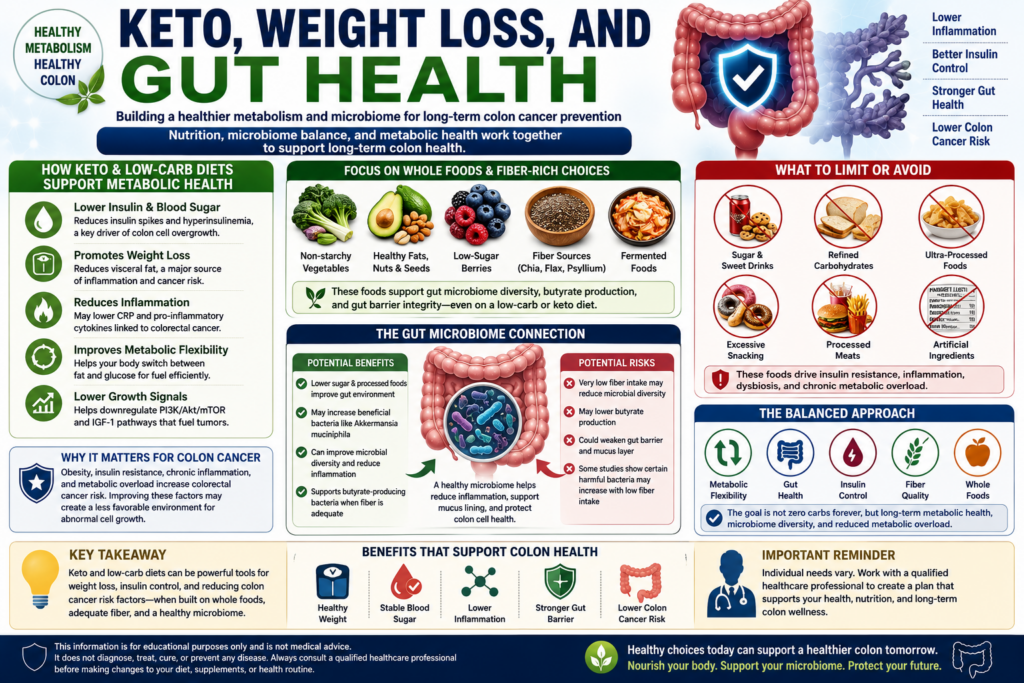
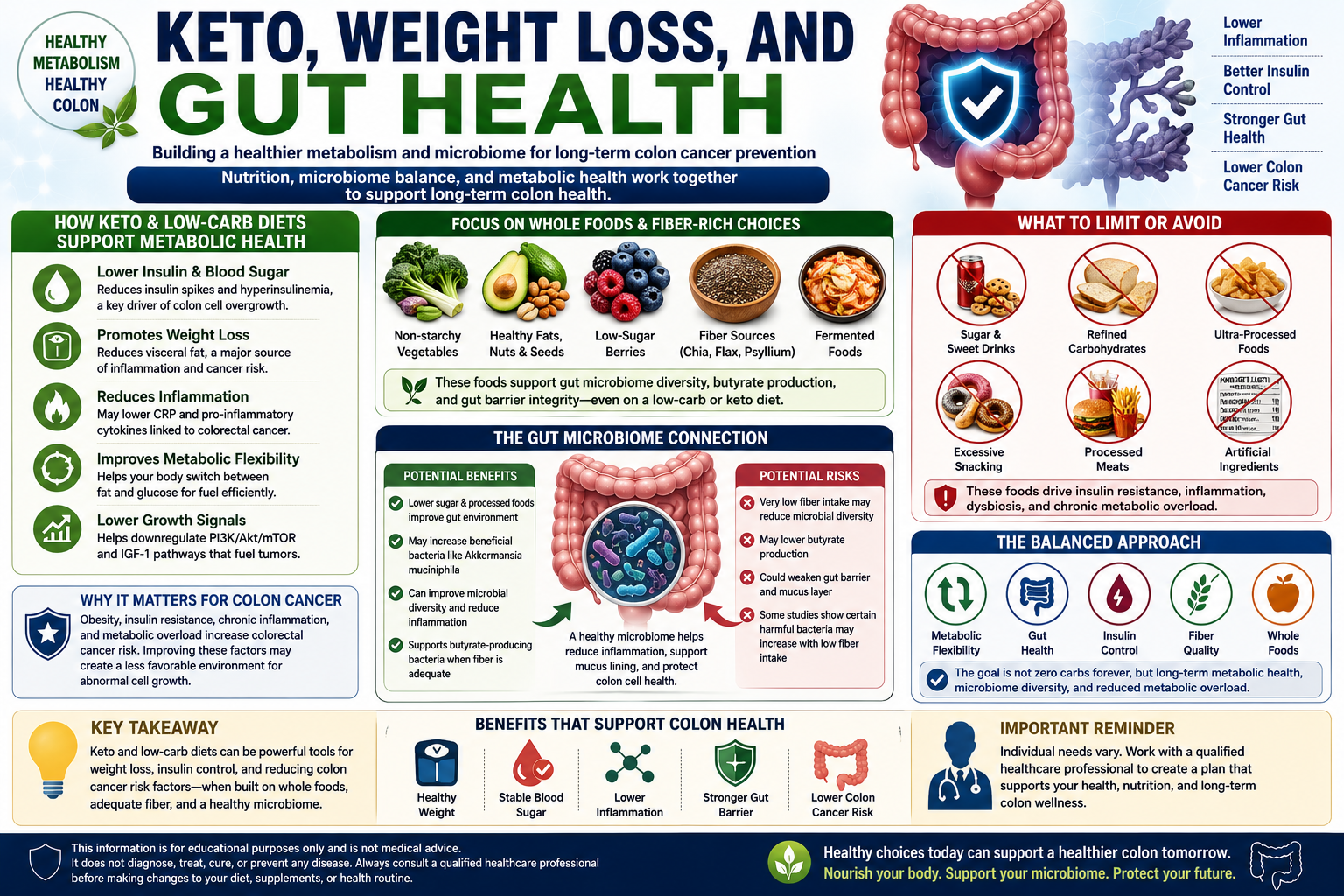
Keto, Weight Loss, and Gut Health
Low-carbohydrate diets, including ketogenic (keto) diets, have helped many people lose weight and improve blood sugar control.
Reducing:
- Sugar
- Refined carbohydrates
- Ultra-processed foods
- Excessive snacking
may improve metabolic health in many individuals.
For long-term colon cancer prevention, the bigger picture appears to involve:
- Metabolic health
- Microbiome health
- Inflammation control
- Body weight
- Gut barrier integrity
- Reducing chronic metabolic overload
Researchers are increasingly studying how these systems interact over years and decades.
How Keto May Improve Metabolic Health
One reason keto receives so much attention is because it can improve several metabolic factors linked to colorectal cancer risk.
Potential improvements may include:
- Lower fasting insulin
- Better blood sugar control
- Reduced insulin spikes
- Weight loss
- Reduced visceral fat
- Lower inflammation markers
- Better metabolic flexibility
These changes may create a less inflammatory and less growth-promoting internal environment.
Insulin, IGF-1, and Colon Cancer
Insulin is not just a blood sugar hormone.
It is also a growth signal.
Chronically elevated insulin and IGF-1 may activate pathways involved in cell growth and survival, including:
- PI3K/Akt
- mTOR
- MAPK
These pathways are heavily studied in colorectal cancer biology.
Keto and low-carbohydrate diets often lower insulin exposure because they reduce rapid glucose spikes and frequent insulin release.
This is one reason low-carbohydrate diets are being studied in metabolic disease and cancer-related research.
Weight Loss and Visceral Fat Reduction
Obesity is one of the strongest lifestyle-related colorectal cancer risk factors.
Visceral fat — fat stored around organs — acts like an inflammatory organ.
It releases inflammatory molecules such as:
- IL-6
- TNF-α
- Inflammatory adipokines
These inflammatory signals may contribute to:
- Insulin resistance
- Chronic inflammation
- Metabolic dysfunction
- Abnormal growth signaling
Keto diets often produce significant weight loss and visceral fat reduction in many individuals.
This may help lower long-term metabolic stress on the body.
Lower Glucose Environments and Cancer Biology
Lower glucose environments may also be beneficial while actively battling cancer because many tumors heavily depend on glucose and insulin signaling for rapid growth.
This concept is connected to the Warburg effect, where many cancer cells rely heavily on glucose metabolism.
However, this article is focused more on long-term colon cancer prevention and possible root causes rather than active cancer treatment strategies.
Prevention and treatment are not identical discussions.
For prevention, the bigger picture is reducing chronic metabolic dysfunction over many years.
Keto and Inflammation
Chronic low-grade inflammation is one of the major themes in colorectal cancer research.
Ketogenic diets may help lower inflammation in some people by improving:
- Insulin resistance
- Body weight
- Blood sugar control
- Fatty liver disease
- Metabolic overload
Some studies show ketogenic diets may reduce inflammatory markers such as CRP.
Lower inflammation may help create a healthier colon environment over time.
Keto and Metabolic Flexibility
Metabolic flexibility means the body can efficiently switch between glucose and fat for energy.
Many researchers now believe metabolic flexibility is a major sign of metabolic health.
A metabolically flexible body may:
- Handle carbohydrates more efficiently
- Avoid large glucose spikes
- Use fat during fasting periods
- Maintain more stable energy
- Improve insulin sensitivity
Some experts believe the healthiest long-term approach is not constant high-carb eating or constant extreme restriction, but improving metabolic flexibility overall.
The Gut Microbiome Question
The relationship between keto and gut health is more complicated than many people realize.
Keto may improve some aspects of gut health by reducing:
- Sugar
- Ultra-processed foods
- Refined carbohydrates
- Excessive snacking
- Chronic inflammation
However, some researchers also question whether extremely low-fiber ketogenic diets over long periods may negatively affect microbiome diversity in certain people.
This is one of the biggest ongoing debates in microbiome research.
Why Fiber Still Matters on Keto
Some poorly designed ketogenic diets contain very little fermentable fiber.
This may reduce:
- Short-chain fatty acid production
- Butyrate production
- Microbiome diversity
- Beneficial bacteria populations
Butyrate is especially important because healthy colon cells use it as a major fuel source.
Researchers study butyrate because it may help:
- Support the mucus lining
- Strengthen gut barrier integrity
- Reduce inflammation
- Support healthier colon cells
This is why many experts now recommend focusing on fiber quality even during low-carbohydrate diets.
Keto and Microbiome Diversity
Recent research suggests the microbiome response to keto may depend heavily on diet quality.
A whole-food ketogenic diet rich in vegetables, nuts, seeds, avocado, olive oil, and fiber-rich low-carb foods may affect the microbiome very differently than a highly processed “junk food keto” diet.
Some newer studies even suggest ketogenic diets may increase beneficial bacteria such as:
- Akkermansia muciniphila
while improving microbial diversity in some individuals with obesity.
Other studies show low-fiber keto patterns may reduce certain beneficial bacteria.
This is why the quality of the ketogenic diet matters enormously.
Whole Foods vs Processed Keto Foods
Not all keto diets are healthy.
Modern processed keto foods may still contain:
- Artificial ingredients
- Emulsifiers
- Seed oil-heavy formulations
- Low fiber
- Highly processed ingredients
A whole-food ketogenic approach usually focuses more on:
- Vegetables
- Nuts
- Seeds
- Avocado
- Olive oil
- Eggs
- Fish
- Whole-food protein sources
- Fiber-rich low-carb foods
This is very different from living on processed keto snack foods.
Keto and Butyrate Production
One concern with long-term very-low-fiber ketogenic diets is reduced butyrate production.
Butyrate is produced when gut bacteria ferment fiber and resistant starch.
Lower butyrate levels may negatively affect:
- Gut barrier integrity
- Colon cell fuel supply
- Inflammation control
- Mucus lining support
This is why some researchers worry about chronically fiber-deficient keto patterns.
A healthier long-term approach may combine metabolic benefits with microbiome support.
Why Experts Now Focus on the Bigger Picture
Many experts now focus less on “all carbs are bad” and more on:
- Metabolic flexibility
- Gut health
- Insulin control
- Fiber quality
- Whole foods
- Reduced ultra-processed foods
The modern research direction is increasingly about:
- Food quality
- Microbiome health
- Inflammation control
- Metabolic health
- Stable insulin signaling
rather than simply labeling all carbohydrates as universally harmful.
Can Keto and Fiber Work Together?
Yes.
A well-formulated low-carbohydrate or ketogenic diet can still include fiber-rich foods such as:
- Non-starchy vegetables
- Nuts
- Seeds
- Avocado
- Chia seeds
- Flaxseed
- Psyllium
- Low-sugar berries
- Fermented foods
- Resistant starch foods if tolerated
This may help support:
- Butyrate production
- Microbiome diversity
- Gut barrier integrity
- Better stool movement
- Healthier colon function
This is why many researchers believe keto works best when paired with microbiome-supportive foods instead of long-term fiber elimination.
The Bigger Picture
Keto and low-carbohydrate diets may help improve several major pathways connected to colon cancer risk, including:
- Insulin resistance
- Hyperinsulinemia
- Obesity
- Visceral fat
- Chronic inflammation
- Blood sugar instability
- Metabolic overload
However, long-term colon health also appears to depend heavily on:
- Gut microbiome diversity
- Fiber intake
- Butyrate production
- Gut barrier integrity
- Whole-food quality
- Reduced ultra-processed foods
This is why the conversation is becoming more balanced and nuanced.
Final Thoughts
Low-carbohydrate and ketogenic diets can help many people lose weight, improve blood sugar control, reduce insulin resistance, and lower chronic metabolic overload.
These changes may support long-term colon health because obesity, insulin resistance, inflammation, and metabolic dysfunction are strongly linked with colorectal cancer risk.
Lower glucose environments may also be beneficial while actively battling cancer because many tumors heavily depend on glucose and insulin signaling for rapid growth.
However, this article is focused more on long-term colon cancer prevention and possible root causes rather than active cancer treatment strategies.
At the same time, some researchers question whether extremely low-fiber ketogenic diets over long periods may negatively affect microbiome diversity and butyrate production in certain individuals.
This is why many experts now focus on:
- Metabolic flexibility
- Gut health
- Insulin control
- Fiber quality
- Whole foods
- Reduced ultra-processed foods
instead of simply labeling all carbohydrates as universally harmful.
The bigger picture appears to be creating a healthier metabolic and gut environment over years and decades rather than focusing on one dietary extreme alone.
Internal Links to Add
- Colon Cancer Reduction: Metabolic Health, Gut Health, and Lifestyle Factors
- The Gut Microbiome and Colon Health
- Fiber and Colon Cancer Prevention
- Resistant Starch and Colon Health
- Constant Eating and Metabolic Overload
- Time-Restricted Eating, Fasting, and OMAD
- Akkermansia muciniphila and Colon Cancer
- Ultra-Processed Foods and Colon Cancer
- Obesity and Colon Cancer
- Hypoxia and HIF-1α in Cancer
External Authority Sources
- NIH / PubMed Central: Ketogenic Diet and Colorectal Cancer — Review discussing ketogenic diets, insulin signaling, inflammation, metabolic pathways, and colorectal cancer biology.
- Nature Communications: Ketogenic Diet, Microbiome, and Colorectal Cancer — Research showing how ketogenic diets altered the gut microbiome and reduced colorectal tumor burden in experimental models through microbiome-derived metabolites.
- NIH / PubMed Central: Ketogenic Diets and Gut Microbiota — Scientific review examining ketogenic diets, microbiome diversity, inflammation, Akkermansia muciniphila, short-chain fatty acids, and metabolic health.
- Nature Microbiology: Low-Carbohydrate Diets and Gut Bacteria — Research exploring how low-carbohydrate diets may alter gut bacteria, mucus integrity, inflammation, and microbial metabolites.
- American Cancer Society: Diet, Weight, and Colorectal Cancer Prevention — Evidence-based guidance covering body weight, diet quality, physical activity, inflammation, and colorectal cancer prevention.
Medical Disclaimer
This article is for educational and informational purposes only and is not medical advice. It does not diagnose, treat, cure, or prevent any disease. Always speak with a qualified healthcare professional about diet changes, ketogenic diets, fasting, digestive symptoms, colon cancer risk, supplements, screening, or treatment decisions.
Research support and mechanistic details were also informed by the uploaded user research notes.